Hand Drawn Frames, Banners Ribbons: A Versatile Toolkit for Creative Design
In the landscape of digital design, there is a persistent and growing desire for elements that feel human, tactile, and authentic. While vector perfection has its place in corporate branding and modern minimalism, many projects require a touch of warmth that only organic shapes can provide. This is where a comprehensive collection of Hand Drawn Frames, Banners Ribbons, and other decorative motifs becomes an invaluable asset for creators. These assets bridge the gap between the rigidity of pixel-perfect geometry and the fluidity of hand-crafted art, offering a solution that resonates deeply with audiences seeking connection and personality.
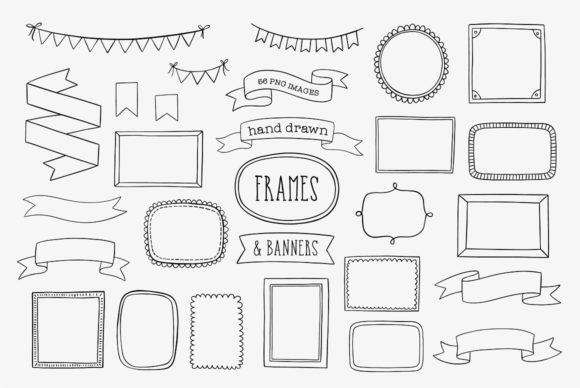
The specific utility of such a collection lies not just in the individual shapes but in the cohesion of the set. When a designer selects a toolkit containing 56 distinct high-quality elements, they are acquiring a unified visual language. This particular set, comprising 28 black variations and 28 white counterparts on transparent backgrounds, offers a balanced palette that serves as a foundational layer for countless creative endeavors. From the intricate details of wedding invitations to the bold statements needed for blog headers, these elements provide the structural elegance required to elevate standard layouts into memorable experiences.
The Artistic Value of Organic Imperfection
One of the primary reasons designers turn to hand-drawn aesthetics is the psychological impact of imperfection. In a world saturated with algorithmically generated content and laser-sharp digital renders, the slight wobble of a line or the uneven curve of a ribbon signals authenticity. It suggests that a human hand was involved in the creation process, fostering a sense of trust and approachability. When integrating Hand Drawn Frames, Banners Ribbons into a project, the creator is effectively borrowing this human quality to soften the edges of their message.
This aesthetic is particularly effective in industries where personal connection is paramount. For instance, in the realm of scrapbooking and personal crafts, the goal is often to preserve memories with a sense of nostalgia. A rigid, computer-generated border might feel cold against a cherished photograph, whereas a sketched frame mimics the look of a pen or pencil drawn by a friend or family member. The texture implied by these drawings adds a layer of depth that flat colors cannot achieve, making the final composition feel more like a physical object than a mere digital file.
Furthermore, the versatility of the black and white color scheme within the set ensures that these elements remain neutral enough to adapt to any color palette. Black ink on a white background (or vice versa) provides high contrast and clarity, allowing the user to overlay these graphics onto colorful photographs, textured papers, or vibrant web backgrounds without clashing. The transparency of the PNG files ensures that the underlying design remains visible, creating a seamless integration where the frame feels like it belongs to the image rather than sitting on top of it.
Technical Specifications and Workflow Efficiency
Beyond the aesthetic appeal, the technical specifications of this collection address critical needs for professional workflows. The inclusion of 56 high-resolution files at 300 dpi is a significant factor for print-ready materials. In the printing industry, resolution is non-negotiable; low-resolution images result in pixelation and blurriness when scaled up. By providing files at 300 dots per inch, this set ensures that whether the output is a small business card or a large poster, the lines remain crisp and the details intact.
The dimensions of these assets, ranging from approximately 12 to 30 inches at their widest points, offer substantial flexibility. This size range allows for both detailed close-ups and expansive full-page layouts. A designer can use a smaller banner as a subtle accent for a section header or scale a larger frame to encompass an entire invitation suite. The fact that the set includes both black and white versions eliminates the need for manual color inversion or recoloring, saving valuable time during the production phase.
For digital creators, the PNG format with a transparent background is the industry standard for compositing. It allows these elements to be dropped directly into software like Adobe Photoshop, Illustrator, Canva, or various web builders without the distraction of a solid white or colored box around them. This "plug-and-play" nature streamlines the design process, enabling professionals to focus on layout and typography rather than spending hours isolating elements or removing unwanted backgrounds.
Practical Applications Across Diverse Industries
The utility of Hand Drawn Frames, Banners Ribbons extends far beyond a single niche, permeating various sectors where visual communication plays a key role. Understanding how these elements function in different contexts reveals their true value as a multi-purpose tool.
Wedding Invitations and Stationery
The wedding industry relies heavily on themes of romance, tradition, and personalization. A hand-drawn frame can transform a standard text-based invitation into a keepsake. Imagine a rustic-themed wedding where the couple wants to convey a sense of countryside charm. A sketched floral border or a whimsical ribbon banner can encapsulate the event details while reinforcing the theme. Unlike pre-made templates that often feel generic, these hand-drawn elements allow for a custom feel even when using stock assets. The ability to mix and match the 56 available pieces means no two invitations have to look exactly alike, ensuring uniqueness for every couple.
Greeting Cards and Personal Correspondence
In the age of digital communication, the greeting card market has seen a resurgence driven by the desire for tangible expressions of sentiment. Whether for birthdays, holidays, or thank-you notes, the addition of a hand-drawn banner can make a message pop. For example, a simple "Happy Birthday" text gains immediate character when wrapped inside a curly, sketched ribbon. The organic lines suggest effort and care, qualities that recipients appreciate. Educators and hobbyists also utilize these elements to create personalized notes for students or clients, adding a professional yet friendly touch to their correspondence.
Web Design and Blogging
For bloggers and website owners, maintaining reader engagement is crucial. Visual hierarchy is established through headers, dividers, and call-to-action buttons. Integrating Hand Drawn Frames, Banners Ribbons into a blog layout can break up walls of text and guide the reader's eye naturally down the page. A sketched border around a quote block can emphasize its importance, while a ribbon graphic highlighting a special offer creates a focal point that stands out from standard geometric buttons. Because these elements are lightweight and scalable, they do not compromise site speed while significantly enhancing the visual appeal.
Scrapbooking and Mixed Media Crafts
Scrapbookers and mixed media artists often blend digital and physical mediums. They may print digital designs to cut out and paste onto physical albums, or use them as overlays in digital scrapbooking software. The variety in this set—ranging from simple borders to complex frames—supports diverse artistic styles. A crafter working on a travel journal might use a map-like border, while someone documenting a family history might prefer a more ornate, vintage-style frame. The high resolution ensures that when printed on cardstock or photo paper, the lines hold their integrity, allowing for precise cutting and assembly.
Business Branding and Marketing Materials
Even in the corporate sector, there is room for creativity. Small business owners, freelancers, and startups often strive to differentiate themselves from large conglomerates. Using hand-drawn elements in logos, brochures, or social media graphics can signal a brand that is approachable, artisanal, and community-focused. A bakery, a boutique clothing store, or a local coffee shop might use these banners to highlight sales or new arrivals on their Instagram posts. The informal nature of the sketches aligns well with brands that want to appear less formal and more connected to their customers.
Strategic Implementation and Design Considerations
While the versatility of these assets is vast, successful implementation requires a strategic approach to design. Simply placing a frame over an image does not guarantee a cohesive result. Designers must consider balance, spacing, and the relationship between the text and the graphic.
Balance and Negative Space: Hand-drawn elements are inherently busy due to their organic lines. It is essential to leave sufficient negative space around the text within the frame to ensure readability. Overcrowding a sketched border with too much information can make the design feel cluttered. The varying sizes of the 56 elements allow designers to choose a frame that fits the amount of content they have, preventing the need to stretch or distort the image.
Color Adaptation: Although the set comes in black and white, these should not be viewed as limitations. In digital design software, the color of these PNGs can be easily altered to match a brand's specific palette. A black frame can be turned into a soft pastel pink for a baby shower or a deep navy blue for a corporate report. However, it is important to maintain the stroke weight consistency when changing colors to preserve the hand-drawn illusion.
Layering and Texture: To maximize the effect, these elements can be layered with other textures. Placing a white hand-drawn ribbon over a textured paper background can create a realistic shadow effect, adding depth to the composition. Conversely, a black frame on a clean white background offers a stark, elegant contrast suitable for minimalist designs. The transparency of the files makes these layering techniques straightforward to execute.
Long-Term Relevance and Trends
Design trends are cyclical, but the appreciation for the handmade has remained relatively constant in recent years. As artificial intelligence generates increasingly perfect and uniform content, the counter-movement toward human-centric design is gaining momentum. Assets like Hand Drawn Frames, Banners Ribbons are positioned to remain relevant because they tap into a fundamental human desire for imperfection and storytelling. They serve as a reminder of the artist behind the work, adding a narrative layer that pure geometry lacks.
Moreover, the educational sector is finding new uses for these tools. Teachers and researchers use them to create engaging presentations, worksheets, and infographics that capture the attention of students. The playful nature of the ribbons and frames can make dry subject matter more inviting, facilitating better learning outcomes. This broad applicability across education, business, and personal hobbies underscores the enduring value of such a comprehensive design toolkit.
Ultimately, the decision to incorporate these 56 high-quality elements into a workflow is a decision to prioritize character and connection. Whether crafting a wedding invitation that will be kept for decades or designing a blog post that needs to stop the scroll, the right frame or banner can make all the difference. By leveraging the technical precision of 300 dpi files and the artistic charm of hand-drawn lines, creators can produce work that is not only visually striking but also emotionally resonant. In a digital world that often feels sterile, these tools bring the warmth of the human hand back into the center of design.